
Search Charlotte Voter Registration
The official NCSBE Voter Search is the first route for one person’s current record. Enter a first and last name, then use the other fields to reduce false matches. County is optional, but selecting Mecklenburg is useful when the person is tied to Charlotte. Choose at least one status group. “Registered” finds current registrations, while “Removed or Denied” opens a separate part of the voter roll. Test names with and without a middle initial. A birth year can distinguish people who share a name, yet the form does not ask for a full birth date. The search fields are:
| Lookup field | Input | Needed? | How to use it |
|---|---|---|---|
| First Name | Text | Yes | Required identity field |
| Middle Initial | Text | No | One initial can narrow a match |
| Last Name | Text | Yes | Required identity field |
| Year of Birth | Select | No | Narrows results without a full date |
| County | Select | No | Choose Mecklenburg from all 100 counties |
| Voter Status | Checkboxes | Yes | Registered, Removed or Denied, or both |
Press Search after setting the status choice. Reset clears the form. A missing match does not prove that a person was never registered, because spelling, status, county, and list-maintenance timing can all affect the result.
The official Charlotte voter lookup screen shows the form used statewide:
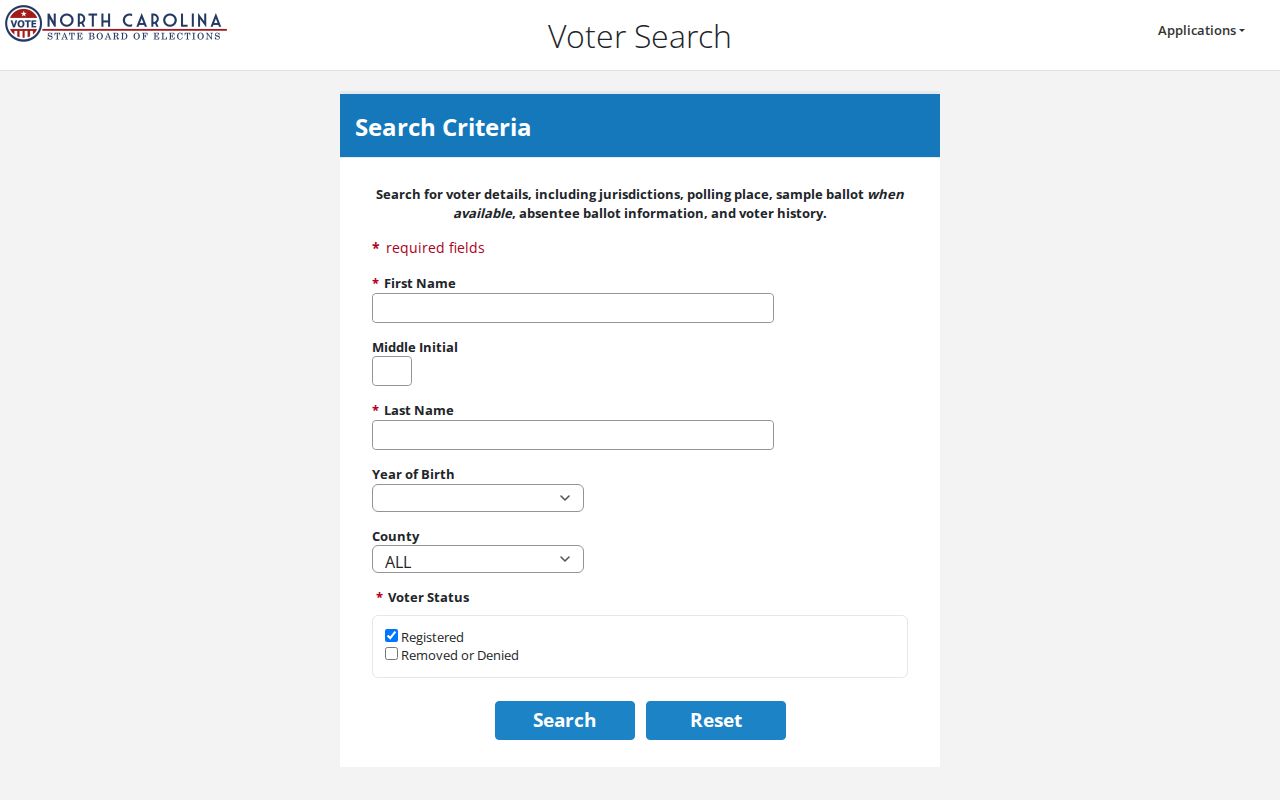
The screenshot makes the distinction clear: first and last names identify the person, while birth year, county, and status refine the request.
Read a Charlotte Voter Match
A successful match is more than a yes-or-no registration check. It can show the voter’s present status, precinct and election districts, Election Day polling place, a sample ballot when one is available, absentee information, and participation history. Those fields help confirm that the right Charlotte resident was found. Compare several attributes instead of relying on a shared first and last name.
The record’s district data describes election geography. It does not define parcel limits or prove that a postal “Charlotte” address falls inside city jurisdiction. Mecklenburg GIS stores jurisdiction and special-district facts separately. Election district assignments should be read only for the civic boundaries they represent.
| Registration status | The current active, inactive, denied, removed, or special status recorded by election officials |
|---|---|
| Precinct and districts | The assigned election areas and available local, legislative, and congressional districts |
| Polling details | Election Day voting place and related election information |
| Ballot information | A sample ballot when published, never the voter’s marked choices |
| Participation history | Elections and voting methods in which the person took part |
Note: A voter record documents registration and participation facts, not ownership, present occupancy, or a vote for any candidate or issue.
Charlotte Voter Records Fields
The individual lookup is only one view. North Carolina also publishes a weekly registration file with a detailed schema. The official February 2026 layout contains 70 columns. Mecklenburg County is identified by county code 60, and its current download is named ncvoter60.zip.
Field groups include county and voter IDs, NCID, name and suffix, status and reason, residence and mailing addresses, phone, registration date, demographic fields, party, birth year or age, ID-related yes-or-no flags, precinct, municipality, ward, and many district descriptions. The file also carries a confidentiality indicator. It does not turn protected identifiers into public data.
The NCSBE voter registration data page presents the current downloads, layouts, exclusions, and historical snapshots:
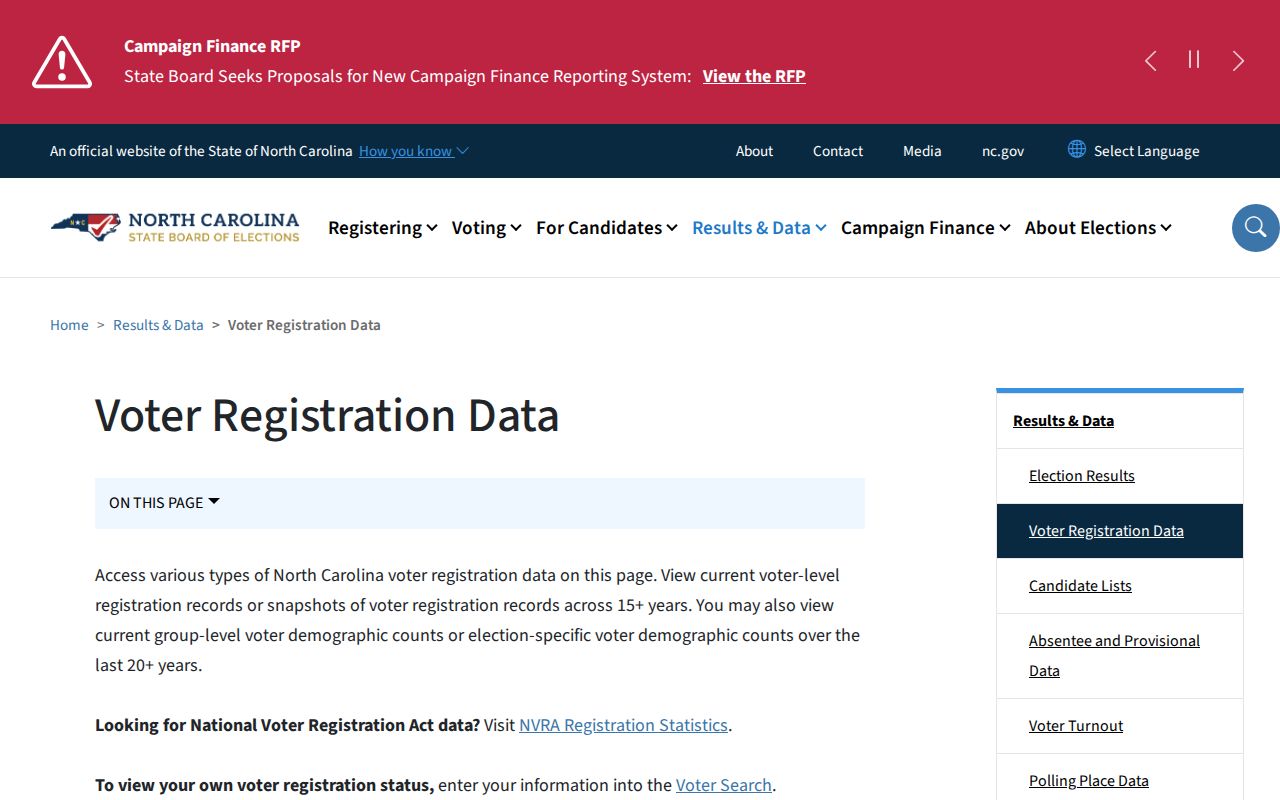
This source is the practical place to confirm the current file name and layout before interpreting a Mecklenburg row. Weekly publication means a saved copy should always be dated.
Decode Charlotte Registration Status
The downloadable voter roll compresses status into short codes. “A” means active, “D” denied, “I” inactive, “R” removed, and “S” temporary military or overseas. These are administrative states, not a narrative about why someone lives at an address. The status-reason field may add context, but it should be read with the file documentation.
List maintenance follows confirmation and federal NVRA processes. Removed voters disappear from the current file when their last vote is more than ten years old. A hash mark or masked date can signal county review, confidentiality, or potentially incorrect information. It is a cue to avoid overclaiming, not permission to fill the gap from another person’s record.
For a current eligibility question, use the individual search and contact election officials. An old downloaded row may no longer reflect what the live system shows.
Confidential North Carolina Voter Records
North Carolina law draws a firm line between the public list and the source documents used to register. N.C.G.S. § 163-82.10 permits public access to listed civic data while withholding sensitive identifiers. Public visibility of an address, party, age, district, or participation fact does not open every field held by an election agency.
Confidential by law. Social Security numbers, full dates of birth, driver-license numbers, submitted email addresses, registration-agency details, and voter-photo-ID photos or copies are withheld. A signature may be viewed but may not be copied or traced outside election administration.
The public download uses a birth year or age rather than a complete birth date. It provides only yes-or-no indicators for license and Social Security information. N.C.G.S. § 163-82.10B adds controls around confidential election information and records. Those limits apply whether the search begins with one Charlotte voter or a countywide file.
Protect Charlotte Voter Addresses
Most residential and mailing addresses belong to the public electronic list. A key exception protects qualifying people who face a safety risk. Protective-order participants and people certified through North Carolina’s Chapter 15C Address Confidentiality Program may submit the required signed safety statement and suppress the residence address in voter records.
The Address Confidentiality Program gives qualifying relocated survivors a substitute address and mail forwarding. Certification lasts four years and can be renewed. The person’s name, precinct, and other public civic data may remain visible even when the home address is protected.
Government data should never be used to defeat that safeguard. A mask, confidentiality flag, or substitute address is the endpoint of the search, not an invitation to reconstruct a private location from parcel, court, or directory sources.
Note: Address protection serves safety, so contact the program or election officials about eligibility instead of testing a protected person’s records.
Download Mecklenburg Voter Registration
The free NCSBE download is the usual route for the full Mecklenburg file. Current registration files refresh on Sunday evenings, and historical snapshots reach back more than 15 years. Save the layout that matches the file date. Column names and coded values need that schema to stay meaningful.
- Open the official registration-data page and choose the Mecklenburg County file,
ncvoter60.zip. - Download the matching layout and read its field definitions, exclusions, and code notes before opening the data.
- Record the publication date, then filter by a sound identifier such as NCID or voter registration number when possible.
- Use name, suffix, birth year, address, and district fields together to separate people with similar names.
The file is useful for civic research, registration statistics, and matching a public profile to its assigned precinct. It remains a snapshot. Check the live voter search or Mecklenburg Board of Elections when present status matters.
Trace Charlotte Voter History
NCSBE voter history files update weekly and carry about ten years of voter-level participation. They include voter number, NCID, party, voted county, precinct, and method. They omit names and demographic fields, so the stable NCID or voter number is the sound link back to a registration row.
For an election-specific Mecklenburg count, NCSBE advises using the statewide history file and filtering the voted_county_desc field. That avoids treating a person’s registration county as proof that the person voted there in every listed election.
Participation is not a ballot. Voter history can show that someone took part and by which method, but it never reveals a candidate, party slate, or issue choice.
Aggregate election statistics span more than 20 years. They answer broader turnout questions, while voter-level history supports careful record matching. Each has a different unit and should not be blended without noting that distinction.
Request Mecklenburg Voter Lists
N.C.G.S. § 163-82.10(c) requires a county board of elections to supply any person with the county list or a list for selected precincts. A request may select by party, gender, race, registration date, precinct, district, voting history, or another reasonable category. The statute allows actual preparation cost.
A magnetic-media service charge may not exceed $25. It cannot include the board’s equipment cost or imputed overhead. Because NCSBE already posts the free weekly county download, that file is simpler for most Charlotte voter-file research. No separate Mecklenburg purchase form was confirmed in the source review, so do not invent one.
When a custom selection is truly needed, describe the county, precincts, categories, date range, and desired available format to the Board of Elections. For broader principles on requesting government material, use the Charlotte public records access overview without treating that general process as a substitute for election law.
Charlotte Elections Records Office
The Mecklenburg County Board of Elections is the local fallback for registration questions, custom county-list requests, and election information. NCSBE remains the keeper of the statewide lookup, weekly files, layouts, and voter-history downloads. Choosing the right channel keeps a request focused.
The Mecklenburg elections office hub collects county services and contact routes:
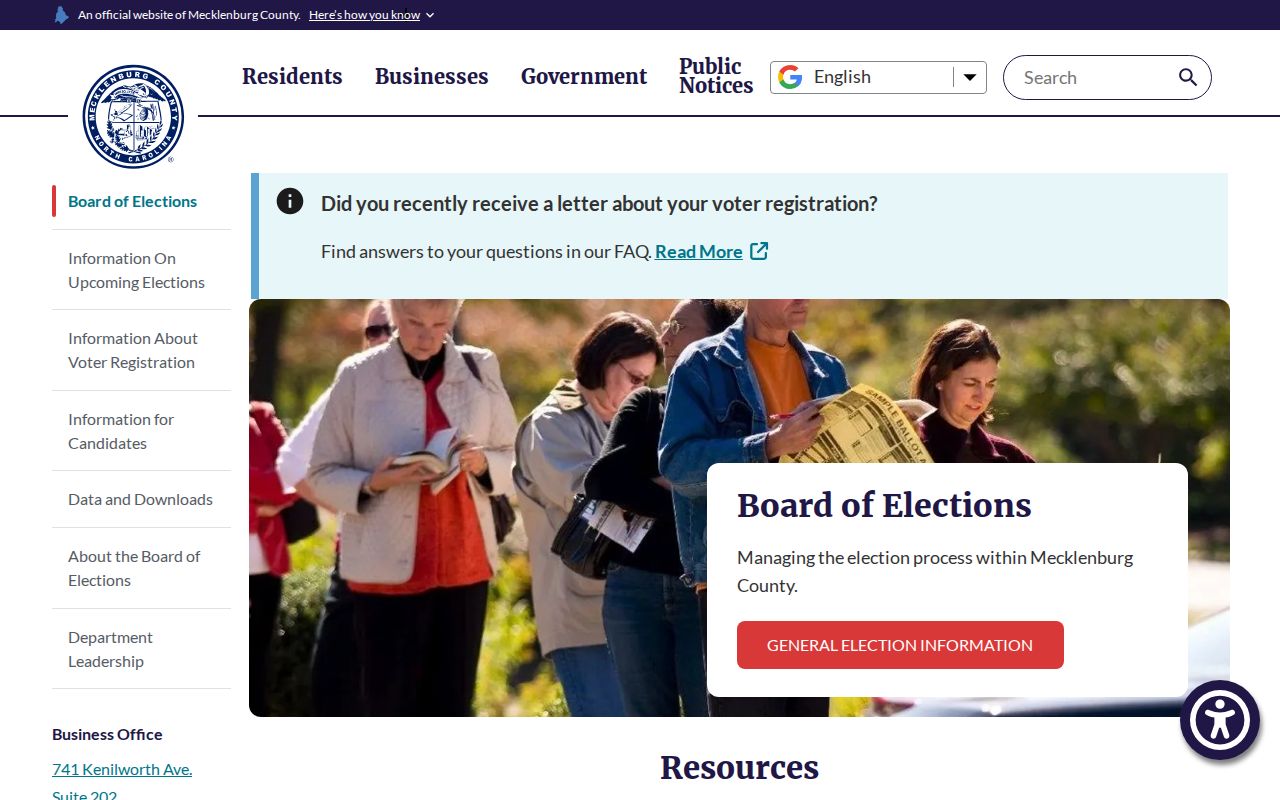
The county screen is the right handoff when the state search does not resolve a Mecklenburg registration issue. State-level help is also available from NCSBE at 919-814-0700, elections.sboe@ncsbe.gov, or PO Box 27255, Raleigh, NC 27611-7255.
Charlotte Voter Records Boundaries
Open voter data still has legal and human limits. North Carolina’s stalking law, N.C.G.S. § 14-277.3A, covers repeated monitoring, observing, threatening communication, and interference without a legal purpose when the conduct creates reasonable safety fear or substantial emotional distress. A first offense is a Class A1 misdemeanor, with higher felony levels for repeat conduct or conduct under a prohibitory order.
Common names also create a basic accuracy risk. Compare NCID or voter number first. If neither is available, keep suffixes and middle initials, then compare status, registration date, district, and address. Never merge two Charlotte voter records just because their names match.
Modern participation downloads are not historical poll books. No authoritative official source established the surviving year range for old Charlotte poll books or registration registers. Researchers should ask the State Archives or the Robinson-Spangler Carolina Room what series exists for the needed election and year rather than relabeling a modern history file as an archival source.