
Charlotte Records Custody at a Glance
Access begins with custody, not the street address printed on a file. Charlotte City Clerk keeps council, board, annexation, ordinance, and city department material. Mecklenburg County keeps land, tax, marriage, and many local vital files. The Clerk of Superior Court holds trial cases, estates, divorces, and special proceedings. State agencies run the broad court, voter, corrections, business, and certificate systems. The table separates the main record sets and their practical access routes.
| Charlotte record set | Custodian | Web route | Coverage and access |
|---|---|---|---|
| Deeds, liens, plats | Mecklenburg Register of Deeds | Historic and modern deed searches | 1763 through February 1990 historic route; March 1990 onward modern route; counter and mail fallback |
| Property and tax | GIS Land Records and Tax Administration | Property Search, POLARIS, GeoPortal | Current web data with a record-to-web update lag; free viewing |
| Court, probate, divorce | Mecklenburg Clerk of Superior Court | eCourts Portal | Mecklenburg digital seam on October 9, 2023; division email, terminal, and paper-file fallback |
| Birth, death, marriage | County Vital Records, Register of Deeds, N.C. Vital Records | Service and certificate-order pages | Certified-copy eligibility applies; statewide registration began in 1913 |
| Arrest, incident, custody | MCSO, CMPD, N.C. DAC | Agency-specific inquiries | Basic public facts vary by law and record; investigative material can be withheld |
| Voter registration | Mecklenburg Board of Elections and NCSBE | Voter Search and weekly files | Public fields are separated from protected identifiers and addresses |
An online index is not the same as an unrestricted file. Sealed and juvenile court matters, adoption records, protected addresses, motor-vehicle personal data, sensitive identifiers, and parts of vital or investigative files stay outside ordinary access. A missing web result can also mean the item remains on paper or in an older system. Ask the named custodian before concluding that no record exists.
Charlotte Records Under Chapter 132
North Carolina Public Records Law defines public material broadly as items made or received in public business, whatever their form. Anyone may ask. State residence and a stated purpose are not required. Under Section 132-6, inspection must be allowed at reasonable times and copies furnished as promptly as possible. The law sets no single statewide count of business days because retrieval, legal review, and volume differ by request.
Inspection is normally free. Section 132-6.2 permits actual reproduction cost, without routine agency overhead. A reasonable special service charge may apply when a request demands extensive technology, clerical work, or supervision. Agencies provide existing records in a medium they can produce, but need not create a report or answer a question. If access is denied, ask for the statute supporting the decision. Section 132-9 provides a court remedy after any required mediation step.
- Custodian
- The office responsible for keeping and producing a specific record.
- Index
- A finding tool with names and citations; it may not include the full document image.
- Certified copy
- A copy formally authenticated by its issuing office, usually for a stated fee.
- Exemption
- A law that withholds a record or field from general disclosure.
Charlotte City Records Request Route
The City accepts requests through its records portal, City Clerk contact channels, or the responsible department. A requester may remain anonymous. Without contact details, though, the requester must monitor the public archive for a response. Names, organizations, request dates, and request text supplied to the City can become part of the released request log. Keep unneeded private facts out of the description. Use names and spelling variants, the department, a record type, and a date range. Choose the closest request category, save the request number and security key, and track status. Prior releases may already appear in Search Archive. The City Clerk routes county and state material away from City Hall rather than trying to fill a deed, court, vital, or election request.
The Charlotte JustFOIA request form shows the New Request and tracking workflow used for city files.
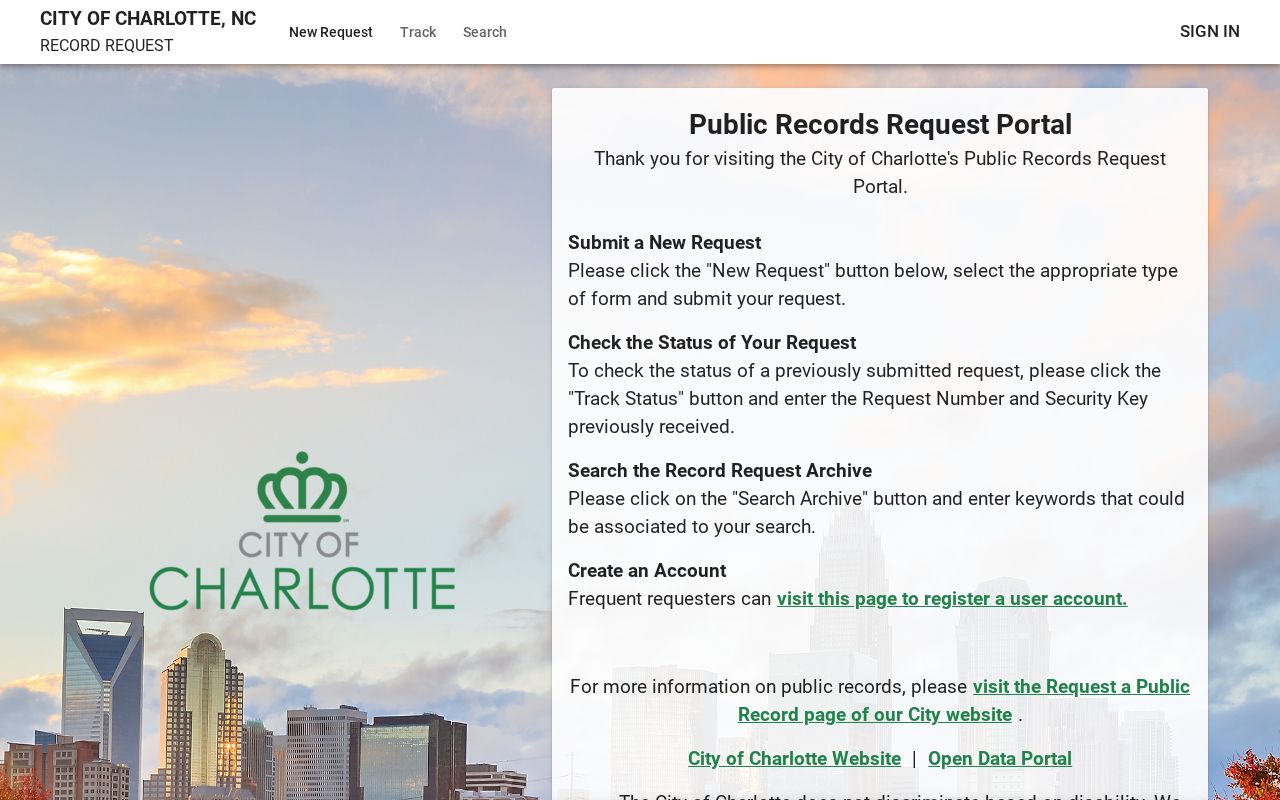
The screen helps identify the request category before a detailed description is submitted. That choice can shorten routing time.
Note: Charlotte does not have to compile a new record merely because the requested facts could be assembled from existing files.
Mecklenburg Deed Records Since 1763
Mecklenburg’s recorded-land trail is unusually deep. Historical research reaches 1763, with a historic route through February 1990 and a modern system from March 1990 forward. The Register of Deeds records deeds, deeds of trust, releases, liens, plats, easements, restrictions, and other notices. Older books and images can require the counter, mail service, or State Archives deed film. The search itself is free, but the selected portal’s image and copy notices control.
Search both party roles. A grantor is usually the party conveying or encumbering an interest. A grantee receives or benefits from it. Try surname variants, first names or initials, document type, and a narrow date range. Once found, book and page or the instrument number provide the strongest direct retrieval key. A recorded deed proves a transaction was placed in the official record, not that the named person still owns or occupies the land.
| Index field | How it narrows Mecklenburg records |
|---|---|
| Name / Last Name | Finds a person or indexed business; test spelling variants |
| First Name | Separates people who share a surname |
| Grantor / Grantee | Limits a party role; search both when tracing title |
| Document Type | Limits deeds, liens, releases, plats, and other classes |
| From / To Date | Sets the recording-date window |
| Book and Page | Retrieves a known older citation |
| Instrument Number | Retrieves a known modern filing |
The Mecklenburg recorded-document search is the source for the county’s party-index interface.
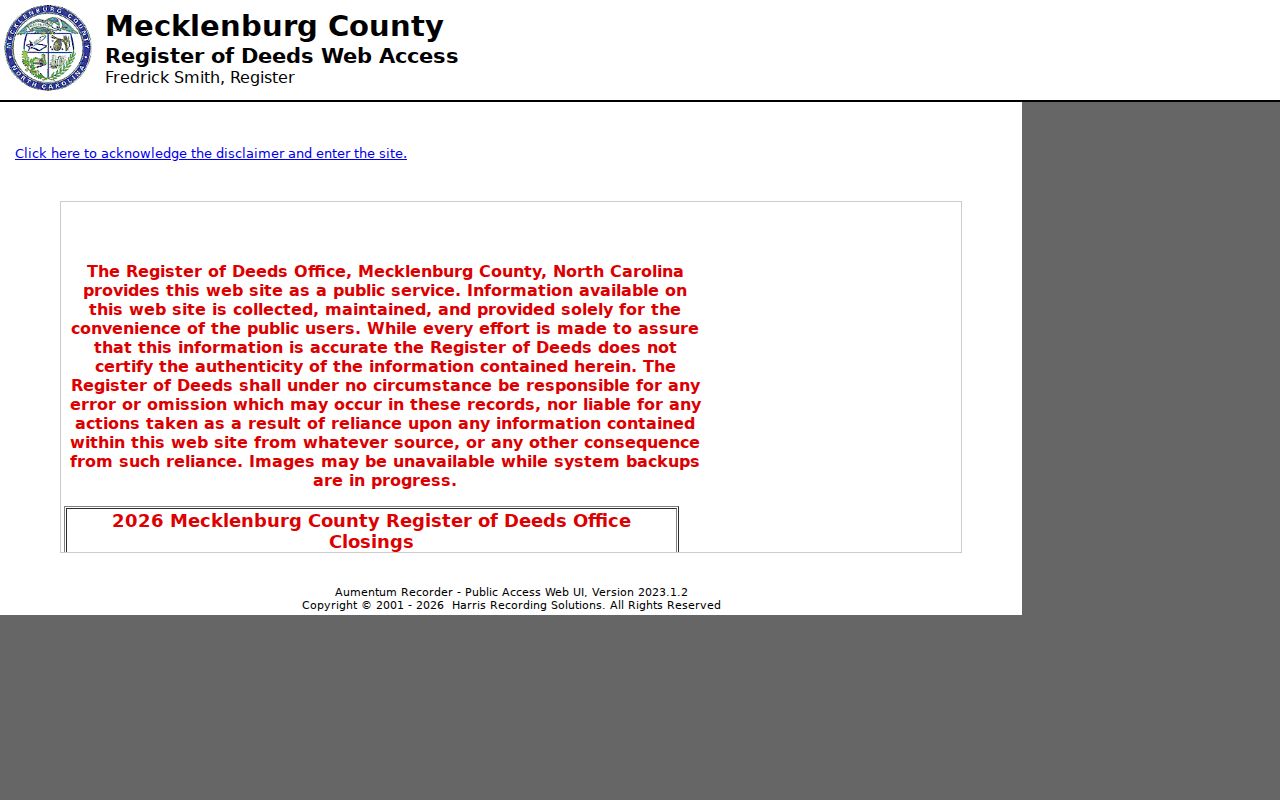
The interface demonstrates why a name, party role, record class, and date window work better together than a broad surname alone.
Charlotte Property Records by Address
GIS Land Records maintains the county parcel ownership file. It separates owner name, situs address, mailing address, and legal description. Situs means the land’s location. The mailing address is where the tax notice goes, so it can differ from the parcel and may provide a useful official contact location. Neither field proves who now lives there.
Property Search accepts owner name, street address, parcel ID, and tax identifiers. POLARIS adds a parcel map, deed and sale references, legal details, and more than 80 overlays. GeoPortal starts with an address and shows jurisdiction and nearby county services. The county warns that ownership can lag recordation. For a recent sale, compare the current property card with the newest deed.
Check jurisdiction first. A postal address reading Charlotte may sit outside city limits. County GIS stores postal city, jurisdiction, ETJ, and special districts as separate facts.
Charlotte Court Records Digital Seam
Mecklenburg County entered eCourts on October 9, 2023. That date forms a real access seam. The Portal can be searched without an account by party or case number, with added filters for business name, location, case type, status, filing dates, attorney, and hearings. A public summary can show party roles, attorneys, filing events, dispositions, hearings, and public documents.
Older criminal, civil, estate, or special-proceeding images may not appear online. Use the division email routes on the Mecklenburg court page, or visit the Clerk’s terminal and paper-file counter. Courthouse terminals can support public searches by defendant, victim, or witness that go beyond the normal web fields. The clerk can quote current copy and certification fees. An allegation or charge is not a finding of guilt.
The system has changed before. Confederate State Department records and the Great Seal remained in Charlotte’s third courthouse for months in 1865. More recently, statewide eCourts reached all 100 counties in October 2025. Neither milestone means every old image became available online.
Note: Search an estate by the decedent’s full name in ordinary Smart Search; the official portal guidance favors that route over a separate party filter.
Charlotte Vital Records Access Rules
North Carolina does not use one simple closure period for every vital file. Section 130A-93 governs certified-copy eligibility and protected fields. Birth and death certificates generally go to listed close relatives, a person establishing a personal or property right, or an authorized agent or representative. Adoption and medical birth data have added limits. Mecklenburg issues certain county certificates, while the state route covers statewide birth, death, marriage, and divorce certificate data.
County certified birth, death, and marriage copies are listed at $10. A standard state search costs $24 for one certificate type and a three-year period, including one copy if found. The search fee is not refunded when no record is found. Extra copies of the same certificate are $15. A divorce certificate is not the court decree; the full judgment belongs with the Clerk of Superior Court.
The North Carolina certificate-order service presents the state routes and applicant requirements.
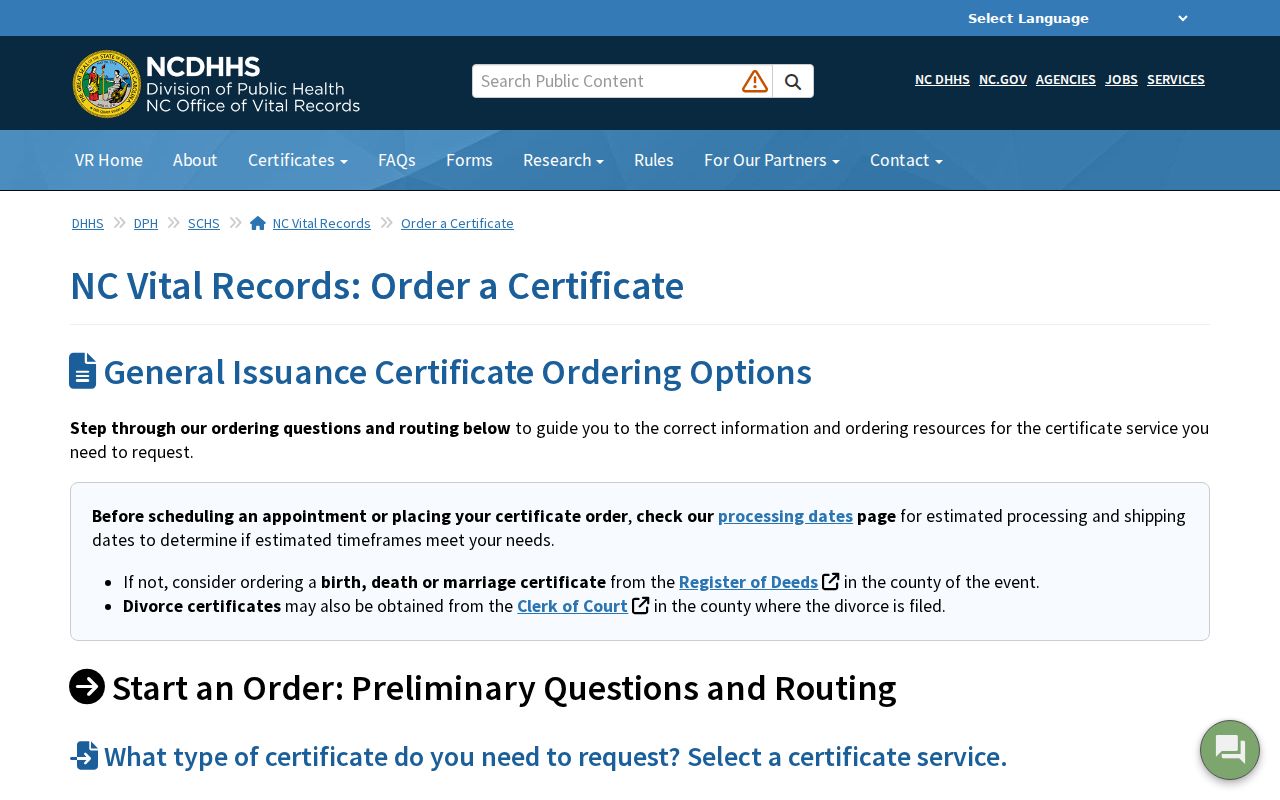
The order screen reinforces the key distinction: a public index reference does not by itself make a certified certificate available to every applicant.
Police and Custody Records in Charlotte
Law-enforcement access depends on the record. The Mecklenburg Sheriff Arrest Inquiry covers roughly three years from arrest or release and reports custody or charge facts, not a conviction. State prison and parole records belong to the Department of Adult Correction. The SBI registry has name and geographic searches for registered adults. Juvenile registry material is not public.
CMPD handles incident, arrest, crash, and calls-for-service files. Section 132-1.4 excludes criminal investigative and intelligence records while requiring release of defined basic incident and arrest facts. Crash reports involve separate driver-privacy rules, identity proof, and applicant eligibility. Body and dashboard recordings follow Section 132-1.4A, not the ordinary Chapter 132 disclosure process.
Charlotte Public Records Offices
The three main local counters serve different legal roles. City Clerk manages Charlotte government material. Register of Deeds records land instruments and issues local marriage and vital services. Clerk of Superior Court keeps court and estate files. Sending a focused request to the right office avoids delay and prevents City Hall from becoming a relay point for county work.
Charlotte City Clerk
600 E. Fourth St.
Charlotte, NC 28202
704-336-2248
Weekdays, 8 a.m. to 5 p.m.
Mecklenburg Register of Deeds
Land, marriage, notary, and county vital services
704-336-2443
Mecklenburg Clerk of Superior Court
832 E. Fourth St.
Charlotte, NC
704-686-0400
Public access weekdays, 9 a.m. to 5 p.m.
Tax Administration and GIS Land Records handle property values, ownership data, parcel maps, and corrections. The Board of Elections owns county election records. State Vital Records, NCSBE, DAC, SBI, and the Secretary of State remain the proper custodians for their statewide systems.
Charlotte Records Kept Off Portals
Public access always yields to a more specific confidentiality law. Sealed, expunged, juvenile, and adoption matters do not appear in the normal court search. Certified vital files have applicant rules. Address Confidentiality Program participants and some protected voters can have actual address data suppressed. Driver records are controlled by federal and state privacy law, and public document images should not expose Social Security, financial account, or similar identifiers.
A commercial profile removal does not erase an underlying deed, parcel, court, voter, or business filing. Source-level remedies are specific. Section 132-1.10 allows a no-fee written request to the Register or Clerk to remove listed sensitive identifiers from a public website image. The requester identifies the document, exact data, and location. Redaction changes the web image, not the legal instrument itself.
Charlotte Records Alerts and Scams
Mecklenburg’s Property Fraud Alert sends notice when a newly recorded document contains a registered name. It is an alert, not title insurance and not a finding of fraud. Verify the filing with the Register. The same caution applies to overpriced deed-copy mailers, unclaimed-property fee demands, jury or warrant payment threats, and messages designed to create panic from public family details.
Use contact data from the official office, not the number in a demand. Compare deed-copy claims with the Register fee schedule, unclaimed-property claims with NCCash, and court threats with the Mecklenburg Clerk. Preserve messages and payment details when reporting a scam. Public facts can help confirm an event, but they should not be used to impersonate, threaten, or pressure another person.
Note: A record alert reports a name match only; inspect the actual instrument and party role before drawing any conclusion.
Request Charlotte Public Records
A precise records request names an existing file or class of files. It does not ask the office to conduct research. Start with the person’s full name and variants, then add the agency, record type, date span, parcel ID, case number, or instrument citation when known. Ask to inspect first if copies are not yet needed. For a large request, seek an estimate before extensive service charges begin.
- Identify the office that created or keeps the record. Use GIS jurisdiction when a Charlotte mailing address may fall outside city limits.
- Check the custodian’s index, archive, or portal. Save any case number, book and page, parcel ID, or prior request number.
- Submit a narrow description through the office’s form, email, mail, or counter. State the date range and preferred available format.
- Ask for an advance cost estimate. Pay only the published copy, certification, media, or justified special service charge.
- If material is withheld, request the written statutory basis. Clarify or narrow the request before using Chapter 132 enforcement options.
Online access is only one channel. Deeds have counter, mail, older-book, and archive routes. Pre-migration court files have division email, terminal, and paper options. Vital certificates have county and state application paths. Historical files may require the State Archives or a Carolina Room appointment.
Lawful personal use. Open Charlotte records support genealogy, estate research, civic review, and fraud checks. Never use them to stalk, harass, intimidate, impersonate, or harm a person.