
Charlotte People Directory Routes
Charlotte people directories are kept by several public bodies and institutions, not one central office. Current contact directories work best when the person has a known public role. County land systems identify an owner, while the deed index identifies parties to a recorded transaction. Library directories and yearbooks place a resident, student, or worker in an earlier year. Choose the source by the relationship that put the name there.
| Charlotte directory | Names and roles | Keeper | How to reach it |
|---|---|---|---|
| City department rosters | Officials, leaders, staff, and board members | City of Charlotte | Department pages, 311, or Clerk |
| CMS campus directories | School staff with title or role | Charlotte-Mecklenburg Schools | Free, school by school |
| UNC Charlotte directory | Faculty and staff contacts | UNC Charlotte | Free public search |
| POLARIS and property search | Parcel owners and mailing names | Mecklenburg County GIS and Tax | Free web search |
| Grantor-grantee index | Parties to deeds, liens, plats, and notices | Register of Deeds | Historic and modern search routes |
| Hill and reverse directories | Past residents, householders, addresses, and occupations | Carolina Room and DigitalNC | Digital examples and appointment access |
| City burial records | People interred in seven city cemeteries | Cemeteries Administration | Telephone request |
A shared name is not enough to merge entries. Keep middle initials and suffixes, then compare the unit, street, year, parcel ID, or instrument number. Role matters too. A parcel owner may not live at the site, and a registered agent may be a service company. A directory is evidence of the listed relationship at the date shown.
Charlotte Government Contact Directories
Charlotte has no verified universal city employee name search. Its department pages form the official directory. They usually publish an employee or office name, role, work phone, email, and service details. Elected-official pages and Boards and Commissions rosters add public civic roles. The Charlotte City Clerk also keeps permanent city records and administers 33 advisory boards and commissions.
| Name | Official, employee, office, or board member as published |
|---|---|
| Role | Title, department, board, or service responsibility |
| Work phone | Direct number or department main line when available |
| Institutional address when the department publishes one | |
| Office detail | Building, service desk, or public contact location when supplied |
If a name is absent, call the department main line or CharMeck 311, which operates weekdays from 7 a.m. to 7 p.m. A narrow request for a current roster can go to the Clerk when the web pages do not identify the right contact. The North Carolina phone book serves a different scope: it lists state employee and agency contacts, not all city or county workers.
Note: A government directory documents an official contact route and role, not a private address or a full biography.
Charlotte Neighborhood Directory Filters
The Neighborhood Organization Directory groups civic associations by council district. Searchers can select district checkboxes 1 through 7 or enter a phrase or keyword. Its alphabetical results may include an organization name, district, primary contact, self-defined boundary, website, and social links.
This Charlotte directory is useful when the goal is to identify a neighborhood representative or learn which association claims an area. It is not a resident roll. The groups submit their own information, so a boundary or contact can be stale. The Community Engagement office accepts updates at cltcommunityengagement@charlottenc.gov. Postal geography also needs care: a mailing address that says Charlotte does not alone prove the property is inside the city. County GIS stores postal city and municipal jurisdiction as separate facts.
Charlotte School Staff Directories
Charlotte-Mecklenburg Schools publishes staff listings at the campus level. Find the school first, then use its faculty and staff directory. A researched CMS example offered Keyword, First Name, and Last Name fields, with 66 entries shown 20 per page. Each entry displayed a full name and a title line, often combining a position code with the person’s role.
| Search control | Use in the CMS directory | Result detail |
|---|---|---|
| Keyword | Search a name or role term | Matching staff cards |
| First Name | Narrow a common surname | Full published name |
| Last Name | Primary person search | Title or coded role |
| Pagination / Next | Move through campus results | Additional staff cards |
A campus main number, address, or fax is the fallback when a staff card lacks direct contact details. School directories also have a strong personal-history use. Current rosters can help reconnect classmates with an educator, while yearbooks and archived school directories establish who was at a campus in a past year. No authoritative current public alumni directory was found.
UNC Charlotte Directory Entries
The public UNC Charlotte directory covers faculty and staff. Unit pages add a text search and Reset control. A result may show a photo, full name and credentials, appointment or title, unit, email, office, and phone. Fields vary by appointment, and some part-time entries omit direct contact.
The captured UNC Charlotte directory interface shows the institution’s public search surface.
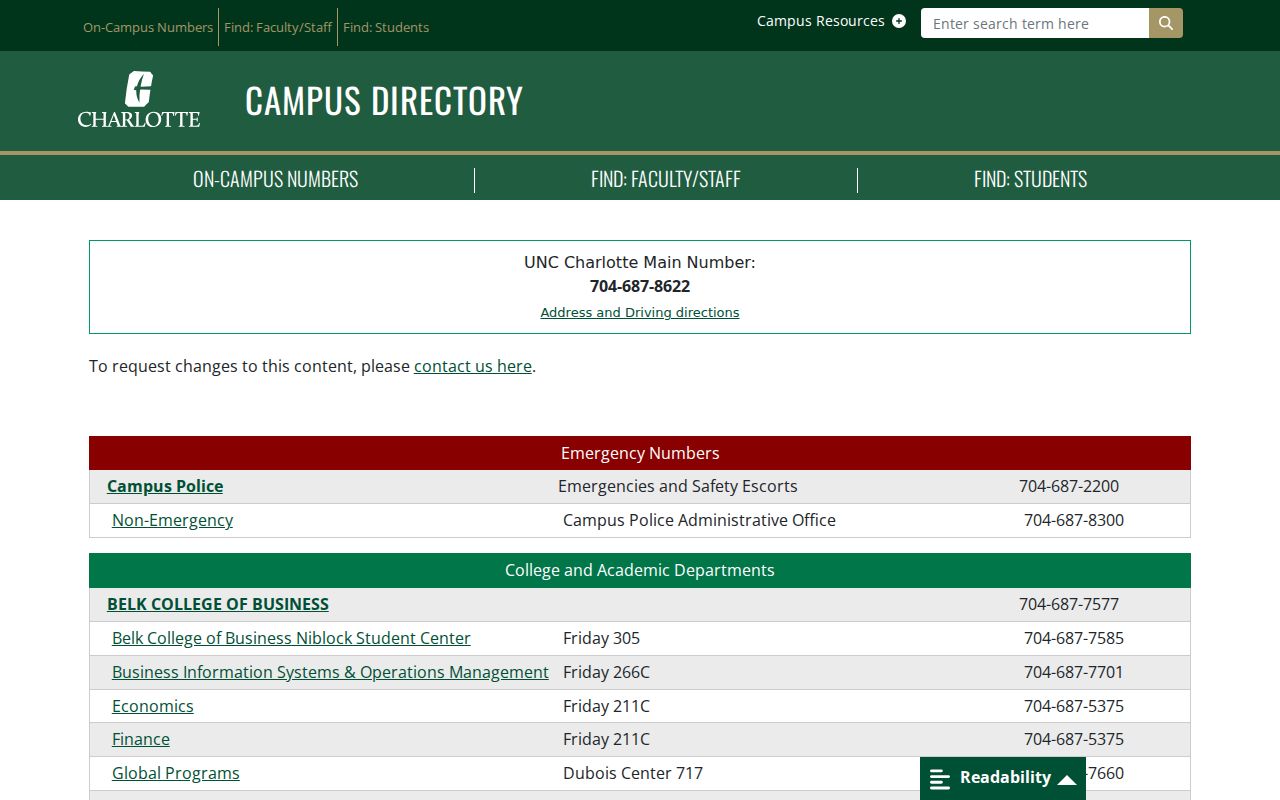
The screen helps distinguish the university-wide directory from a unit roster, where richer role details may appear.
Use the published unit and title to test identity. Names alone can collide across a large university. The Charlotte College catalogs in local finding aids span 1903 through 1984, and UNC Charlotte manuscript collections cover education, politics, planning, civil rights, local industry, writers, and photographers. Those archives can supply historical context that a current contact card cannot.
Charlotte Owner Name Directories
Mecklenburg land systems work as owner directories, but each describes a distinct role. POLARIS and the county property search accept an owner name, street address, or parcel ID. Results can show owner name, parcel number, situs address, tax mailing address, jurisdiction, legal description, assessed values, and deed references. The situs is the land’s location. The mailing address is where the tax notice goes. Neither field proves who now occupies the parcel.
The deed index is a transaction directory. A grantor is usually the party conveying or encumbering an interest; a grantee is the receiving or benefited party. Search both roles and name variants, then use the book and page or instrument number to identify the document. Mecklenburg recorded-land research reaches 1763. The historic route covers 1763 through February 1990, while the modern system begins in March 1990.
- Situs
- The physical parcel address, which may differ from the owner’s mail destination.
- Grantor and grantee
- The indexed parties on opposite sides of a recorded land transaction.
- Parcel ID
- A stable county land identifier that helps separate similar names and changing street addresses.
GIS warns that online ownership can lag a recent recording. Check the latest deed when timing matters. For detailed access rules and copy procedures, use the Charlotte public records overview.
Charlotte Business Name Directories
A complete business-name check takes more than one directory. The North Carolina Business Registration Search can search an organization or a person’s last, first, and middle name. “Name starting with” and “contains all words” help when punctuation or a legal suffix is uncertain. Results establish the entity, status, registered agent, offices, and filings, but not beneficial ownership.
The Assumed Name Search adds entity type, text, personal-name fields, date range, and county filters. Its statewide filings begin December 1, 2017. Earlier Charlotte DBA records require the Mecklenburg Register of Deeds. UCC search adds debtor names, and a sole proprietor may appear under a personal name. Professional boards remain separate, including the State Bar, Medical Board, Nursing Board, General Contractors, Real Estate Commission, and other occupation-specific regulators. Charlotte has no single local license directory that replaces those state sources.
Historical Charlotte Directory Methods
The Robinson-Spangler Carolina Room holds city directories, Mecklenburg newspapers, public and private school yearbooks, maps, photographs, manuscripts, family histories, and local government documents. DigitalNC provides Hill’s Charlotte directory examples from 1938, 1940, and 1945/46. The complete physical year run was not verified, so ask Carolina Room staff for a year-by-year shelf check instead of treating those examples as continuous coverage.
Hill’s 1940 volume works in more than one direction. Its alphabetical residents section can connect surname to address and occupation. A Street and Avenue Guide or householder section can move from an address to a resident. A numerical telephone directory reverses a phone number. The same book also contains apartments, schools, churches and clergy, organizations, cemeteries, government, hospitals, railroads, and business classes. One cited 1904 Charlotte directory even introduces automobiles through Osmond L. Barringer & Co.
| Charlotte source era | Named coverage in research | Useful link |
|---|---|---|
| Recorded land | 1763 to present through historic and modern systems | Parties, dates, instruments, land trail |
| Charlotte Observer | 1888 to present | Obituaries, notices, announcements, businesses |
| CMS directories | 1934 to 1981 | School staff and institutional ties |
| School ledgers | 1861 to 1918 | Older education records |
| County Home records | 1902 to 1942 | Institutional residents and cemetery |
Chronology is crucial. A 1940 entry speaks to that publication year, not the present. Move forward through later volumes, check the street section for new householders, and pair the timeline with deeds, obituaries, estates, and census schedules. Pre-1760 Mecklenburg wills belong in Secretary of State records because county will jurisdiction begins in 1760. That jurisdiction seam can explain why a name is absent from a county index.
Charlotte Library Directory Collections
The Robinson-Spangler Carolina Room collections extend beyond printed city directories. Charlotte City Government Records cover 1872 through 1959, including 1872-77 salary and receipt papers from fire, police, cemetery, and street departments. Finding aids also identify school-commissioner oaths, planning records, Charlotte College catalogs, Chamber papers, clubs, banks, baseball, and personal collections. The source capture presents the library’s directory and archive holdings.
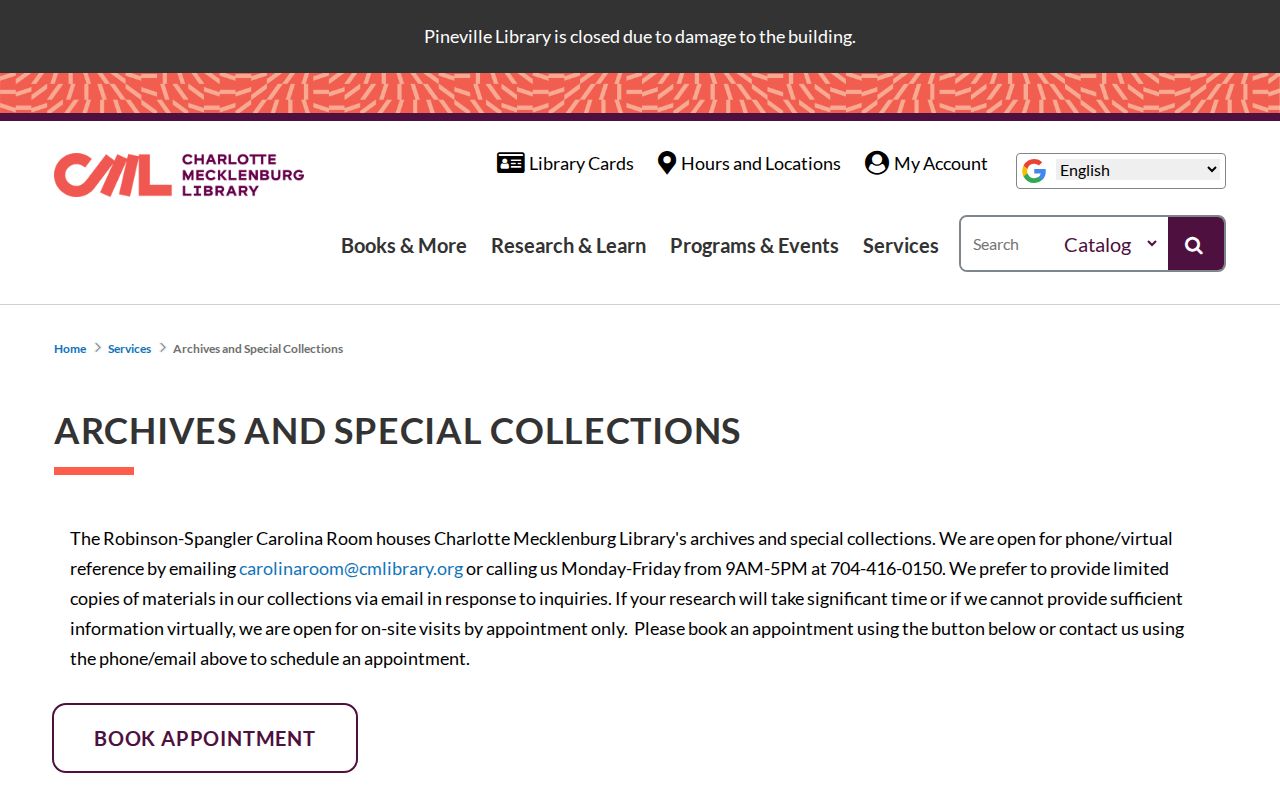
The collection categories show why a failed catalog search should lead to staff contact, finding aids, and an appointment instead of ending the inquiry.
Current Carolina Room access includes phone or virtual help and appointment-only onsite use, Monday through Friday from 9 a.m. to 5 p.m. Call 704-416-0150. Limited copies may be sent by email. Research is normally capped at two staff hours per request, and fee-based work is $15 per half hour. During the library’s 2025 catalog migration, some catalog and account functions were temporarily incomplete. A missing catalog hit during that transition did not prove that an archival item was absent.
Trustees also considered more than $150,000 in digitization equipment and an 86-inch historical-map table for over 600 maps and aerial images. Those tools can help reconcile vanished streets, subdivisions, annexations, and old address-parcel links.
Charlotte Burial Community Directories
Charlotte maintains Elmwood, Evergreen, Oaklawn, Pinewood, North Pinewood, West Pinewood, and Old Settlers cemeteries. There is no verified citywide online burial name search. Cemeteries Administration supplies individual burial records by phone at 704-336-2123. A record may corroborate a full name, burial time, cemetery, plot, and family links, but callers should confirm which fields are available for the person requested.
Community membership lists need a different standard. Charlotte’s Neighborhood Organization Directory is public and self-reported. Private clubs, churches, reunion groups, and alumni rosters often have no public master directory. For older ties, use church material, cemetery records, yearbooks, Chamber collections, local newspapers, and manuscript finding aids. These sources are strongest when one date and place can be checked against another.